
Toenail fungus tends to develop slowly over time, so what seems like no big deal can turn into an embarrassing foot problem.
Having horrible-looking toenails when summer rolls around means you might hide your feet. Instead of hiding your poor toenails, visit us at ENRICH Clinic and let’s see what’s wrong with your toenails. If you have toenail fungus, don’t try to treat it at home – if it hasn’t worked by now, then it’s not going to.

What is toenail fungus?
A fungal infection of the nails means the nailbed has become infected with a type of fungus, which might be yeast, mould or tinea.
Signs you have a toenail fungus
You might think you knocked your toe on something and it’ll heal up. While this may be true, damage to the nail or nailbed is a prime opportunity for a pathogenic fungus to move in and make itself at home.
Nails take a long time to grow back, especially toenails, so it might be a year or more before you realise whatever it is, it’s not going away. That’s the insidious nature of toenail fungus. It creeps up on you.
The visible signs of toenail fungus are coloured areas or streaks, flaking or crumbling, and misshapen nails. Your nails may be pitted or have yellow spots in the half-moons, or nails may thicken.
When a toenail fungus comes from foot tinea
Tinea can infect spaces between the toes, an infection otherwise known as athlete’s foot. This fungus can then spread to the toenails, especially if you damage your nail or nailbed while you have tinea.
If you have foot tinea, you need to treat the tinea to reduce reinfection once we’ve successfully treated your toenail fungus.
Toenail yeast infections
Yeast infection of the nails usually starts close to the cuticle (the area where your toenail connects to the foot). The skin at the nail edge may become swollen and red and start to lift off the nail. Coloured marks can begin to appear on the nail and spread outwards, while the nail may lift off its bed and be sore when you push on it.
Toenail mould infections
Mould can also grow around or underneath the nail, and appear similar to tinea infections.
What else could it be? Other nail disorders
Many problems can affect the toenails, which is why it’s important to get a proper diagnosis from a dermatologist.
- Bacterial infection
- Psoriasis
- Eczema
- Dermatitis
- Warts
- Nail thickening
At ENRICH Clinic, we’re experts in toenail fungus and have a range of high-tech treatments to solve your nail problems once and for all.
If you are looking for the latest in toenail fungus from the scientific community, look no further than this scientific review.
Once we’ve confirmed the diagnosis, we can choose the best treatment. Toenail fungus can sometimes be incredibly challenging to treat due to the nature of the nailbed and getting treatments into the space between the nail and the nailbed.
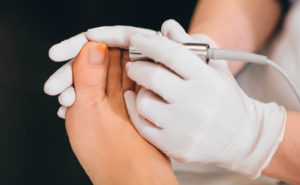
A combination of treatments may work very well, but don’t expect a quick fix. Treating toenail fungus can take some time.
Don’t forget that nail fungus is contagious! Don’t share nail tools, shoes, socks or slippers.
Topical antifungal treatment
Topical treatment of toenail fungus with an antifungal cream is often a long-term commitment. The cream requires frequent application, but if used correctly, can be very successful in eradicating stubborn toenail fungus.
Topical antifungals are a suitable treatment in many cases, but we may opt to use our state-of-the-art lasers.
Lasers treatments for toenail fungus
Laser beams emit radiation that can kill fungus via heat inside an affected nail. Laser treatments for toenail fungus are comfortable, and 1-3 sessions are usually all that’s required.

Skip the home remedies – you need the strong stuff
Most of you would have already tried treating toenail fungus at home with home remedies – and failed. If this has worked for you, then bravo, but for most of you, toenail fungus will follow you around, slowly destroying the lovely smooth, pale surface of your toenail without mercy.
Traditional home remedies for toenail fungus include vinegar, baking soda, essential oils, garlic and mouthwash. These ingredients are proven bug killers, but there are limitations to their reach.
You can treat the fungus with the areas of your toenail that you can reach, but the hidden reservoir of fungus is what keeps it sticking around. Unless you can get under the toenail or into the crevices, your attempts will fall flat.
Save yourself some time and effort and head to the dermatologist to solve your toenail fungus problems.
Set your feet free!
Contact us for a consultation
ENRICH Clinic

 Rough nails are associated with a handful of dermatological conditions, and thus diagnosing the cause requires some good investigative skills on the part of your dermatologist.