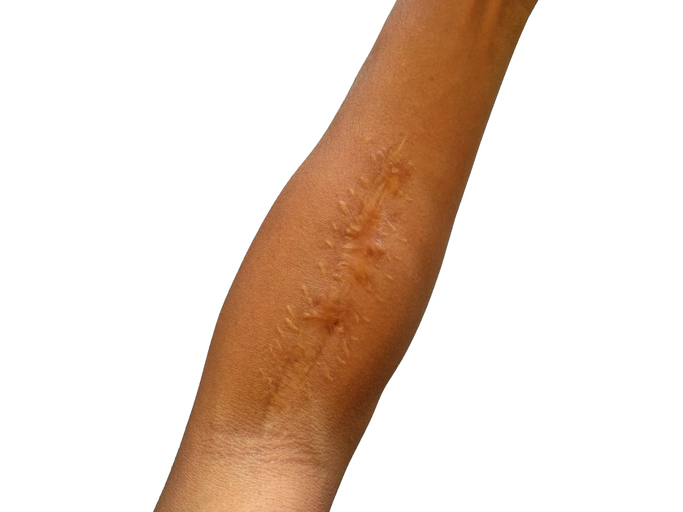
If you have a scar that’s thicker and raised compared to normal scars, you could have hypertrophic scars. While not dangerous, they can be a concern due to their appearance and, sometimes, discomfort.
The good news is hypertrophic scars can respond well to various treatment options, but it’s crucial to consult a healthcare professional for proper diagnosis and personalised guidance. Self-treating these scars can be counterproductive and even harmful. The following sections will explain why.
What causes a hypertrophic scar?
When you get a wound, your body goes through three healing stages:
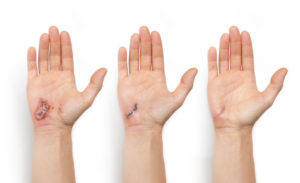
- Inflammatory phase. This is like the cleaning-up phase. Your body sends white blood cells to fight infection and clean the wound.
- Proliferative phase. This is the rebuilding stage when cells called fibroblasts lay down collagen to help rebuild tissue.
- Remodelling phase. This is the polishing stage. Your body removes extra collagen and rearranges things to make the scar smooth.
The first stage, inflammation, is crucial for how your scar will turn out. Some chemicals called cytokines help control this process. In normal healing, the balance between “pro-inflammatory” cytokines (that cause inflammation) and “anti-inflammatory” cytokines (that calm things down) is important. If this balance is off, it can lead to thicker, raised scars like hypertrophic scars or keloids.
In the second stage, a protein called TGF-beta tells the fibroblasts how much collagen to make. In normal healing, TGF-beta levels are just right. But in hypertrophic scars and keloids, fibroblasts produce too much collagen.
This abnormal response to wound healing is more common after deeper wounds, like those from surgery, burns, or tattoos. People with specific genes, skin colours, or ages (younger adults) are more likely to get them. They also tend to show up more in certain regions of the body.
What is the difference between a keloid and a hypertrophic scar?
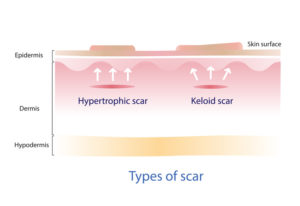
Both keloids and hypertrophic scars are raised, thickened formations that develop after skin injury or surgery. But, there are some key differences between the two:
Growth
- Keloids grow beyond the original wound boundaries, often spreading outwards and forming irregular shapes.
- Hypertrophic scars remain confined to the original wound area, not extending past its edges.
Appearance
- Keloids can be red, pink, or purple, often with a smooth, shiny surface. They also contain an abundance of collagen arranged in a haphazard pattern.
- Hypertrophic scars are typically red or pink, with a bumpy or ridged texture. The flattened outer layer has increased collagen fibres organised in parallel to the middle layer of the skin.
Progression
- Keloids tend to continue growing over time, even after the wound has healed.
- Hypertrophic scars usually reach a peak size within a few months and then stabilise or slowly flatten over time.
Treatment
- Keloids can be more challenging to treat and often require multiple treatment approaches due to their persistent nature.
- Hypertrophic scars may respond better to treatment and have a higher chance of improvement.
Prevalence and risk factors
- Keloids
- Less common than hypertrophic scars.
- More frequent in those with Fitzpatrick skin types III to VI.
- Seem to have a stronger genetic predisposition, with a higher incidence in populations with darker skin complexion and families with a history of keloid formation.
- Hypertrophic scars
- Common and can occur in all races and ages
- May be more common in populations with darker skin tones
- More likely to develop on areas of skin under tension, such as over joints or on the chest
- No clear genetic link identified
Here’s a table summarising the key differences:
| Feature | Keloid | Hypertrophic scar |
| Growth | Extends beyond wound | Confined to wound |
| Appearance | Red/pink/purple, smooth/shiny | Red/pink, bumpy/ridged |
| Progression | Continues growing | Reaches peak size, stabilises/flattens |
| Treatment | More challenging | Responds better |
| Skin types | More common in III-VI | May be more common in darker skin tones |
| Genetic link | Strong | None identified |
| Collagen arrangement | Haphazard | Parallel |
Note that these are general guidelines, and there can be some overlap in the characteristics of keloids and hypertrophic scars. These two can also be mistaken for something else, such as:
- Malignant dermatofibrosarcoma protuberans (DFSP). This slow-growing soft tissue tumour can appear similar to a keloid. It usually occurs on the legs, trunk, or arms and may be red, pink, or brown. DFSP requires surgical removal, and mistaking it for a keloid could lead to delayed diagnosis and treatment.
- Cutaneous scleroderma. This autoimmune disease can cause thickening and hardening of the skin, sometimes resembling a keloid. It can affect any body part but commonly involves the hands, face, and upper chest. Cutaneous scleroderma requires different treatment approaches than keloids, and misdiagnosis could lead to inappropriate therapy.
These “mimickers” pose a risk in treating keloids or hypertrophic scars because what helps one can be harmful to the other. For example, corticosteroids, which are often used to reduce keloid appearance, can worsen DFSP.
If you have a raised scar, it’s best to consult with a dermatologist or other healthcare professional for a proper diagnosis and treatment plan.
Can hypertrophic scars go away?
While hypertrophic scars themselves won’t completely disappear, they often improve significantly, even without treatment, becoming less noticeable and flatter. This process can take weeks to months, depending on the size and location of the scar.
If the scar is located on a joint or other area that restricts movement or you’re bothered by the scar’s appearance, various treatments can help.
What is good for hypertrophic scars?
Injections
Corticosteroids, given every few weeks for several months, are often the first-line treatment for hypertrophic scars. They reduce inflammation and collagen production, helping to flatten and soften the scar.
If your scar is stubborn, steroids may be given with fluorouracil to inhibit cell growth, preventing excessive scar tissue formation.
Laser therapy
This noninvasive approach uses targeted laser beams to remove excess scar tissue and stimulate collagen remodelling. Different types of lasers–pulsed dye and fractional ablative– are used depending on the scar’s characteristics.
Radiofrequency
A newer option with promising results is radiofrequency ablation. This technique uses radio waves to heat and destroy scar tissue, potentially reducing its size and thickness.
Microneedling
This minimally invasive procedure involves creating tiny punctures in your scar tissue with fine needles. This stimulates collagen production and improves the scar’s texture and appearance.
Surgery
Surgery might be considered in rare cases if other options haven’t been successful or if the scar significantly impacts movement. This can involve scar excision and reconstruction, followed by additional treatments to minimise scar formation.
Other treatment options
- Silicone gel sheets. These sheets, worn for several hours daily, can help flatten and soften scars.
- Pressure therapy. Applying continuous pressure to the scar with garments or bandages can help reduce its size and thickness.
- Massage therapy. Gentle massage can improve blood circulation and promote scar healing.
Flatten your hypertrophic scars at ENRICH
The best treatment for your hypertrophic scar depends on its specific characteristics, individual goals, and doctor’s recommendations. At ENRICH, treatments range from laser and radiofrequency to micro-needling but can involve several effective treatment strategies.
Contact us to talk about your scarring, and we’ll put together a plan to help your skin health.

 Having a vaginal birth isn’t a walk in the park. The older you are and the more babies you have, the less your vagina bounces back post-birth, leaving many mamas with a looser-feeling vagina than you might prefer.
 Who is Juliet, and why would I let her near my vagina?